I just got my PSAT scores back. Now what?

– Edison Prep Exclusive –

Student reviewing PSAT scores on laptop for college prep guidance.

Published in 2018, our “I just got my PSAT scores back. Now what?” blog post has received over 20,000 clicks over the last six years. School counselors, parent groups, and others shared the wisdom in this article, the sole goal of which is to de-stress the PSAT process by making sure students prepare for the PSAT at the right time—not too early or too late. We’ve included the most up-to-date information below!

(Last updated Nov 5, 2024)

2024

What to Know about the PSAT

The digital PSAT was first administered in October 2023. For the majority of students, the PSAT is an opportunity to become familiar with the adaptive nature of the digital SAT, to compare their performance to the PreACT or ACT, or simply to build stamina for standardized tests. The PSAT is a great way to demystify standardized tests in a low-pressure way that cannot be used against you in college admissions. Take it seriously, and take it every year your high school allows you too!

And, don’t stress if your PSAT score isn’t as impressive as you thought it would be. There are far greater rewards for submitting high SAT and ACT scores to your universities of choice!

Structure of the PSAT

The PSAT has 98 questions across two sections (Reading and Writing, and Math), matching the SAT in both number of questions and time allotted. A student’s performance on Module 1 determines whether they get an easier or harder Module 2, making the PSAT section-adaptive.

SectionLength (minutes)Number of Questions
Reading and Writing (Module 1)

3227
Reading and Writing (Module 2)3227
Math (Module 1)

3522
Math (Module 2)

35`22
Total134 (2 hours and 14 min)98

Interpreting Your PSAT Score Report

Let’s take a look at an example student’s report! Your student’s report should look very similar, with, of course, some differences in score and percentile.

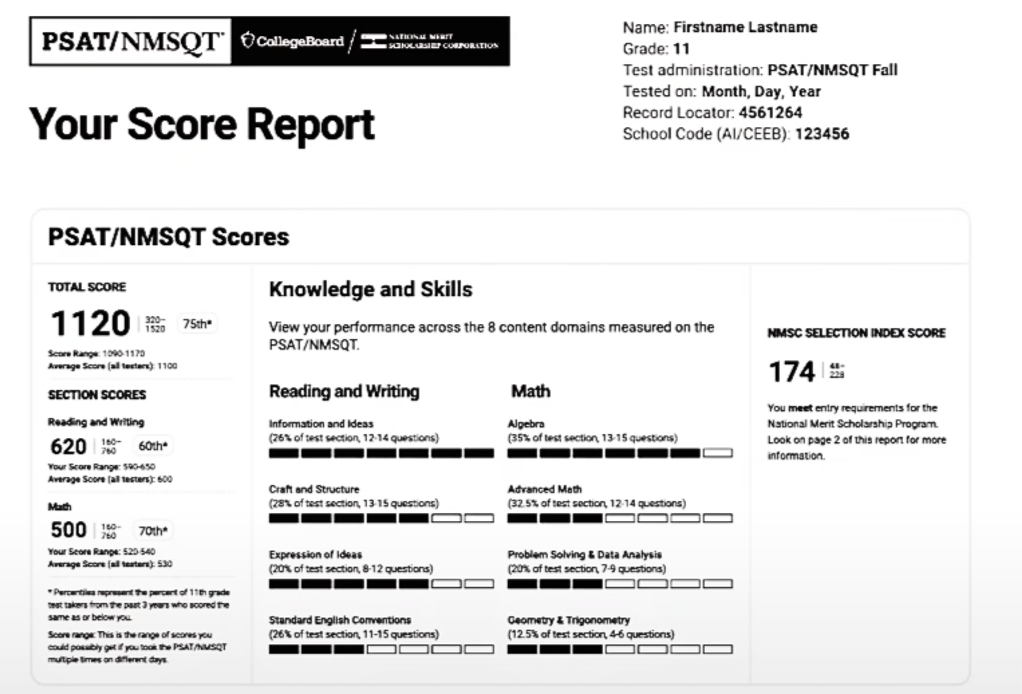
  • Total Score

    Yes, this is different from the SAT’s score range of 400 to 1600. Each section is scored on a range from 160 to 760, rather than SAT’s 200 to 800. The ‘75th*’ refers to the percentile, or the percent of students who received a score the same as or below yours.

  • Knowledge and Skills

    Your performance on each of the four domains within Reading and Writing and the four domains within Math. Unfortunately, the College Board does not release the actual questions and answers from test day, so this is the as specific as it gets.

  • NMSC Selection Index Score

    Every year, the National Merit Scholarship Corporation considers the 50,000 highest-scoring students for National Merit Scholarship Program recognition by using their NMSC Selection Index Score. This score ranges from 48 to 228—it’s calculated by doubling your Reading and Writing score, adding this to your Math score, then dividing that number by 10. For example, a student with a 540 on Reading and Writing and a 580 on Math would receive an index of (2*540+580)/10 = 166.

Hand-drawn, scribble-style arrow pointing downward, suggesting direction or emphasis on content below.
Student reviewing PSAT score report with Edison Prep tutoring services.

What’s a Good Score?

Despite what it might seem like in conversations in the lunchroom and in the stands at sports games, the average score for a sophomore is 910-920 (about halfway between 320 and 1520), and the average score for a junior is 1000.

For sophomores hoping to shoot for National Merit as juniors, a score of 1300 “cold” (taking the test without preparation) is a hopeful sign, and deliberate steps should be taken to prepare for the junior year PSAT. Download CollegeBoard’s Bluebook application, then use free PSAT/NMSQT full-length practice tests to track your progress.

Ultimately, a “good” score depends on your percentile (how you compare to other students in your grade level) as well as your aspirations for future tests and your potential college list. The PSAT simply shows how you performed on that day—use it to guide, not hinder, your academic growth by targeting any weaknesses and honing any strengths.

Will my student qualify to become National Merit Semifinalist?

  • The junior year PSAT is the only route to qualifying for National Merit.
    • The sophomore PSAT is just for practice.
  • There are two levels of National Merit Recognition: Commended and Semifinalist—either one is an honor!
    • The top 16,000 students of the more than 1.5 million students who take the PSAT are named Semifinalists. 15,000 of these fill out an application to attempt to move on to the Finalist round, some of which are offered scholarships directly from the National Merit Corporation, some of which are offered scholarships by U.S. companies, and some of which are sponsored by institutions.
    • The next 34,000 students are named Commended students. 50,000 students receive National Merit Recognition.
  • How to become a National Merit Semifinalist
    • To become a National Merit Semifinalist, you have to score above your state’s cutoff, which corresponds to the top 1% of students in your state—but this can vary by a few points each year and by state! (For reference, in fall of 2021, Georgia students needed a score of 218 or higher to be named Semifinalists.) Students who score highly enough will be notified of their Semifinalist status in September of 2023.
  • For most National Merit recipients, the National Merit award is more of an honor than a financial benefit.
    • The scholarship money awarded to the top students directly from the National Merit Corporation is nominal compared to merit aid that a high SAT or ACT score might earn. However, there is one big exception: there are over 25 colleges who give full tuition all the way up to a full ride (and dozens of others who give smaller amounts) for National Merit Finalists who indicate that school as their first choice on the National Merit application.
  • Maximizing Merit Aid
    • Unless a student is starting at a very high Sophomore PSAT score, far more money is likely to be earned via merit aid from the real SAT or the real ACT than from the PSAT at 95%+ of colleges.

Auburn Case Study:

National Merit Semifinalist requires a top 0.5% score, and at most colleges would earn a student $2,000-4,000 per year. However, at Auburn, students who earn a 29 ACT (a top 10% score) can save $11,000 per year (300- 500% as much, with 2000% as common of a score), and those with a 33 ACT (a top 2% score) can earn $16,500 per year! The bar is far lower and the rewards many times higher via merit aid from the SAT and ACT.

Competitive Merit Scholarships for Non-Residents
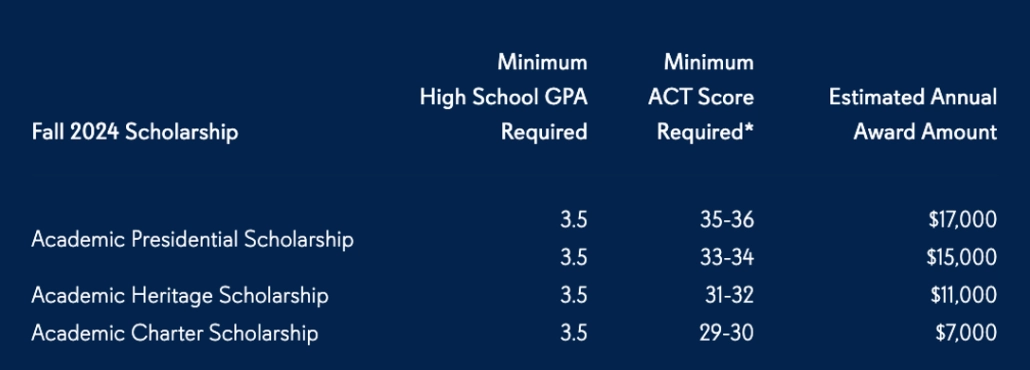
Table listing Fall 2024 scholarship opportunities with eligibility requirements and award amounts. Scholarships include the Academic Presidential Scholarship ($17,000) for a 3.5 GPA and ACT scores of 35-36, Academic Heritage Scholarship ($15,000) for 3.5 GPA and ACT 33-34, Academic Heritage Scholarship ($11,000) for 3.5 GPA and ACT 31-32, and Academic Charter Scholarship ($7,000) for 3.5 GPA and ACT 29-30.
Curved, hand-drawn arrow pointing downward and to the left, conveying emphasis or guiding attention to content in that direction.

Can the PSAT Predict Your SAT or ACT Score?

From our experience, most students improve their score by about 30-40 points from the PSAT sophomore year to the PSAT junior year if no preparation beyond attending school and being a year older and wiser occurred. If a student practices or participates in a PSAT preparation program, that increase is likely higher. However, PSAT scores don’t necessarily predict SAT or ACT scores. The best way to see where your student stands is to take mock tests—preferably, one of each. You can set SAT and/or ACT score goals by looking at universities’ class profiles: in particular, the middle 50th percentile of incoming students. These ranges can vary widely depending on the university’s rank, class size, and many other factors.

So what do I do now?

If you’re a junior:

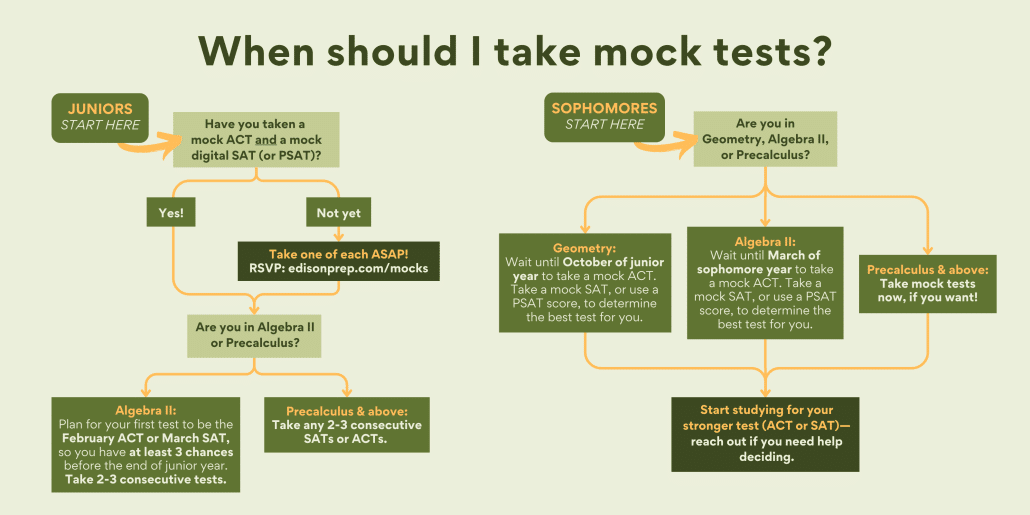
Now is the time to begin SAT/ACT prep in earnest. Early Action deadlines loom and there are only a few test dates left of each exam before senior year. If you’re taking Algebra II as a junior, plan for your first test to be the February ACT or March SAT so you get enough math under your belt. Just reach out and we can advise you on SAT vs. ACT (you can take a mock ACT ASAP if you don’t have any scores yet).

If you’re a sophomore:

First, don’t start SAT or ACT preparation too early. If you’re a sophomore in Algebra II, focus on your grades for the next few months. Take a mock SAT and mock ACT in the spring semester so you can map out a summer/fall/winter testing plan. A high GPA is even more important than extracurricular involvement, leadership opportunities, volunteer hours, and the like.

Should I practice for next year’s PSAT?

To qualify for National Merit Semifinalist as a junior, you can only miss 4-7 questions on the entire test. Out of our more than 7,000 students who have shared their PSAT scores with us since 2016, only one has had a “cold” sophomore PSAT score below 1300, but earned National Merit Semifinalist status in their junior year.

  • If your “cold” sophomore year PSAT is at least 1300, prepare for next year’s test and make a run at National Merit!
  • If your “cold” score is below 1300, the PSAT should be viewed as low-stress practice for the SAT, and you should focus on GPA, your extracurriculars, and the actual SAT and ACT.

When should I take mock tests?

Here’s a helpful flowchart!

Guide to timing and preparation for mock tests in high school math and science courses.